

Human Rights
RATCH, as a good corporate citizen, respects human rights in its business operations and work processes, adopting the UN Guiding Principles on Business and Human Rights (UNGPs) as the operational framework for the interactions with stakeholders including employees, community and suppliers as well as the provision of favorable work environment and safety. The Board of Directors in 2022 endorsed the Human Rights Policy and enforced it on 30 June 2022. The Human Rights Due Diligence was subsequently conducted by external experts to assess human rights risks and impacts, reporting and information disclosure.
In addition, human rights are a significant part of RATCH’s sustainability strategy and the ultimate goal is the entire enterprise, including subsidiaries, affiliates and joint ventures, reports zero violation of human rights by 2030.
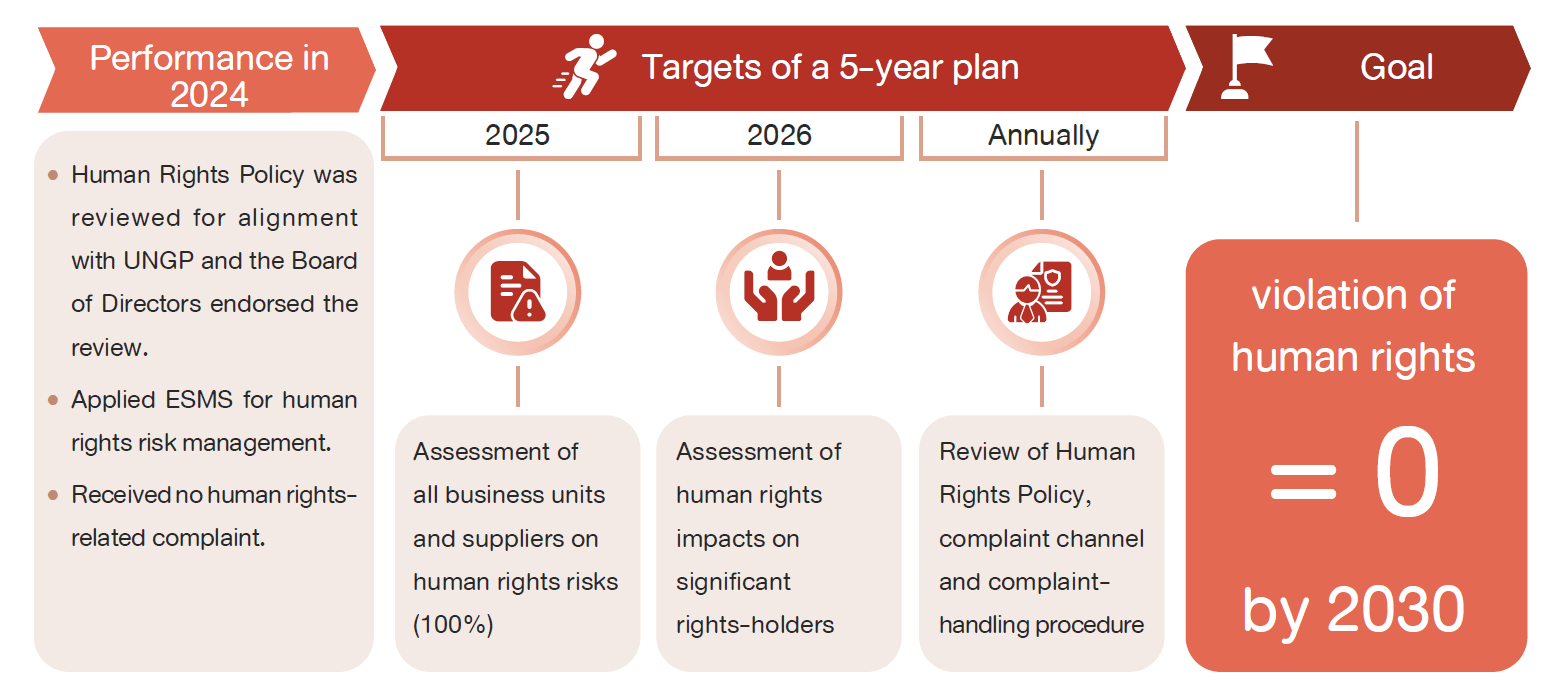
Human Rights Policy
RATCH Group Public Company Limited is aware that respect for human rights is an essential for business operations. The Human Rights Policy is promulgated to demonstrate our commitment to uphold, support and promote the respect and protection of the basic rights and dignity of all individuals involved, in consistent with domestic legislation, international human rights principles and business best practices, namely:
- Universal Declaration of Human Rights (UDHR).
- United Nations Guiding Principles on Business and Human Rights (UNGPs).
- Principles of the United Nations Global Compact (UNGC).
- Declaration on Fundamental Principles and Rights at Work and Core Conventions of the International Labour Organization (ILO)
- OECD Guidelines for Multinational Enterprises on Responsible Business Conduct.
- Children's Rights and Business Principles (CRBP).
The Company is committed to respecting and upholding international principles that support human rights and fair labor practices, in alignment with internationally recognized standards for responsible business conduct.
The Human Rights Policy applies to the Company and its controlled entities in Thailand and overseas in conducting business. Furthermore, the Company shall encourage its joint ventures, business partners, suppliers and relevant parties in the supply chain of the Company and its controlled entities in Thailand and overseas to conduct their business with respect for human rights by applying or adapting to the Human Rights Policy. (more details on Human Rights Policy)
| More Info: | The Code of Conduct |
| Human Rights Policy | |
| Corporate Sustainability Policy |
Human Rights Due Diligence: HRDD
In 2022, RATCH started implementing the Human Rights Policy. Being aware that human rights is an essential factor for successful and sustainable business, the company kicked off the development of the Human Rights Due Diligence, starting with the Human Rights Risk Assessment (HRRA) to identify actual risks, potential risks and preventive and mitigative measures for the possible impacts on the company’s rights holders.
In 2023, RATCH assessed human rights impact on employees and reviewed the human rights risk register, conducted in 2023, and the results showed all the risks involving stakeholders – employees, suppliers/contractors, customers, community and other rights-holders, were unchanged.
HRDD was carried out in line with the United Nations Guiding Principles on Business and Human Rights (UNGPs), regarded as international guidelines. The process involved:
Human Rights Risk Assessment: HRRA
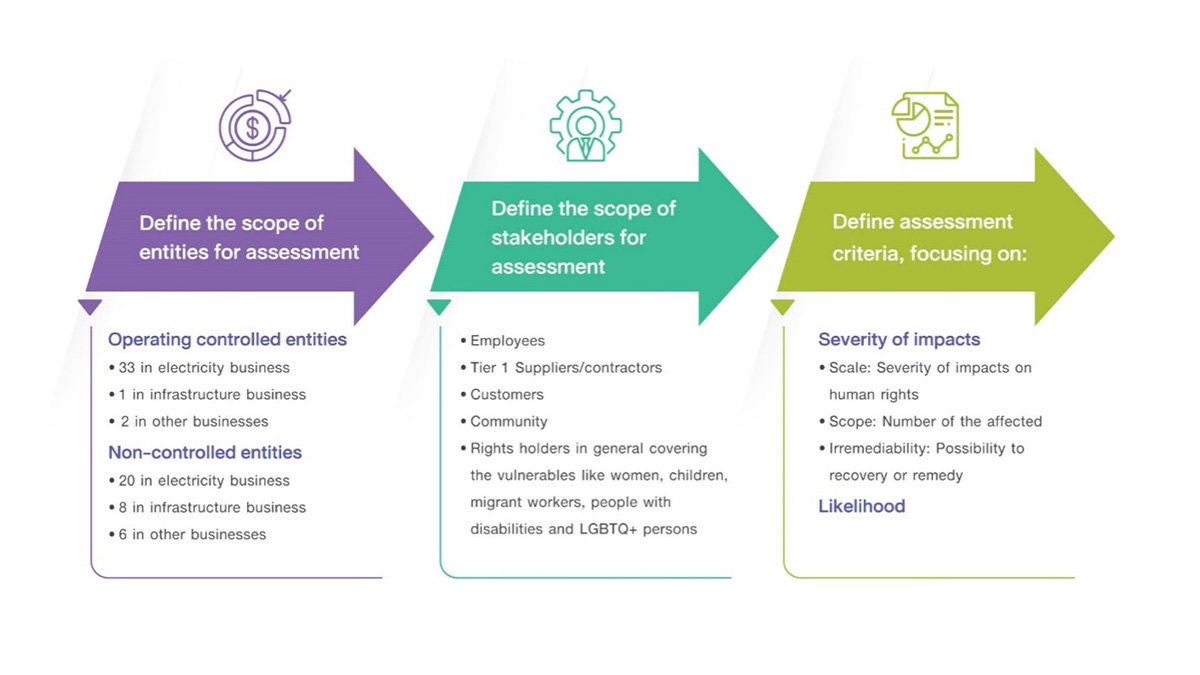
RATCH assessed the human rights risks in activities of the company, operational controlled entities and suppliers, covering both actual and potential risks.
Assessment Method
- Identification
- Analize issues in the company’s activities and study actual risks faced by companies in the same industry, global trends and emerging events during the COVID-19 pandemic.
- Consider an act a risk if it may cause impacts on rights holders and the vulnerable.
- Identify women, pregnant women, children, people with disabilities, the elderly, LGBTQI+ persons, indigenous peoples, migrant workers and third party’s employees as the vulnerable.
- Assessment of Inherent Risk
- Assess and prioritize existing risks that have not yet been controlled.
- Assessment of Residual Risk
- Assess and prioritize the risk remaining after mitigation measures have been applied.
- Prioritization of Risks
- Prioritize salient issues from extreme residual risks and identify mitigating measures to reduce the risk level.
Human Rights Risk Assessment Process
Rights Holders and Human Rights Issues Under Assessment
| Involved rights holders | Assessed human rights issues |
|---|---|
| Employees |
|
| Tier1 Suppliers/Contractors |
|
| Community |
|
| Customers |
|
| All rights holders |
|
Assessment result and risk management
| Key risks of RATCH and operational controlled entities | Preventive measures |
|---|---|
| Supplier/contractor’s health and safety |
|
| Community’s health and safety |
|
| Community’s quality of life |
| Risks of RATCH andcontrolled entities’ suppliers/contractors | Preventive measures |
|---|---|
| Health and safety of suppliers’ employees |
|
| Risks of non-operationalcontrolled entities | Preventive measures |
|---|---|
| Treatment of labor andcomplaint channel |
|
| More Info: | Whistleblowing Channel |
Human rights risk management and prevention
The risk assessment found that a human rights issue significant to RATCH, subsidiaries and joint ventures concerns the health condition and safety of community, employees and suppliers. All entities showing the risk have properly established and exercised prevention and control measures. The actions implemented in 2024 can be summarized as follows:
| RATCH Cogeneration Power Plant | ||
|---|---|---|
| Rights holders | Suppliers/Contractors | Community |
| Actions implemented in 2024 |
|
Establishment of the Community Engagement Committee (involving public and civic sectors) as a stage for joint discussion with community and relevant stakeholders. |
| Ratchaburi Power Plant | ||
|---|---|---|
| Rights holders | Community | Suppliers’ employees |
| Actions implemented in 2024 |
|
Apply the Stop Work Authority and Lock-out/Tag-out (LOTO) with suppliers’ works, particularly in maintenance that involves many of suppliers’ employees. |
Human rights issues under Environmental and Social Management System
In 2024, RATCH kicked off the Environmental and Social Management System (ESMS) as a tool in managing possible human rights risks from the operations of the Company, subsidiaries and joint ventures and impacts. Human rights issues have been clearly incorporated into the ESMS manual and guidelines, for convenience of use. Most human rights issues are included in the risk assessment process.
In 2024, RATCH organized a training course for relevant offices about the ESMS manual and 13 key work procedures.

Employee-related Human Rights Impact Assessment
In 2023, RATCH conducted the employee-related human rights impact assessment, to affirm the 2022 risk assessment results. The activity in 2023 entailed the employees of the Company and operational controlled entities as they are considered the most important internal rights-holders. It served as a review of the latest assessment of impacts on employees and the evaluation of the efficiency of current actions and preventive measures.
The assessment was conducted through an opinion survey involving employees in all business functions working in Thailand and abroad.
Steps of human rights impact assessment

Scope of employee-related human rights impact assessment
Mapping of sample groups: The sample groups involved the employees of RATCH and operational controlled entities, separated into 5 groups according to the nature of their business units’ operations. The sample size was based on a scientific method, to achieve an appropriate number of samples and complete representation of each business group.
| Type of Operations | No. of employees (persons) |
No. of respondents (persons) |
|---|---|---|
| Fossil fuel power plants | 241 | 203 |
| Renewable power plants | 105 | 94 |
| Infrastructure | 10 | 10 |
| Electricity-related and energy | 251 | 214 |
| Head Office | 207 | 124 |
| Total | 814 | 645 |
Scope of the survey : Involving employees working in Thailand, Lao PDR, Vietnam, Indonesia, Singapore and Australia.
Scope of the assessment : The issues covered in the assessment were based on the Company’s human rights issues gathered in 2022 and extended to cover the risks in international contexts and of other leading companies. The human rights aspects covered in the assessment are as follows:
| Employee-related human rights aspects |
Likelihood of impacts |
|---|---|
| Work environment | Poor work environment unaligned with legal requirement involves overtime, rest period, holidays, workplace environment, etc. |
| Occupational health and work safety | Health impacts, work safety, security measures, and examination of tools/equipment or protective personal equipment |
| Freedom of association and collective bargaining | Rights to join a group to defend employees’ interests |
| Discrimination and intimidation |
|
| Illegal workforce | Human trafficking, forced labor, child labor |
Summary of employee-related human rights risk assessment results
| Assessment aspects | Risk level |
|---|---|
| Work environment | Low |
| Occupational health and work safety | Low |
| Freedom of association and collective bargaining | Low |
| Discrimination and intimidation | Low |
| Illegal workforce | Low |
The assessment of human rights risks on the employees of RATCH and controlled business entities in 2023 showed the low level of risks in all aspects; work environment, occupational health and work safety, freedom of association and collective bargaining, discrimination and intimidation, and illegal workforce. Nevertheless, RATCH took employees’ recommendations into consideration and outlined additional actions aside from the prescribed prevention and control measures. The actions implemented in 2024 are summarized below:
| Recommendations | Continuous communications on the Human Rights Policy and guidelines through communication channels for employees’ engagement in the prevention of internal violation |
|---|---|
| Actions in 2024 |
|
| Recommendations | Inspection of work condition; and review of pay, compensation and welfare for more fairness and suitability to each employee’s job description/performance as well as continuous increases in the cost of living |
| Actions in 2024 |
Reviewed and adjusted welfare, ensuring it was equitable, fair and suitable to each employee’s job description/performance and the current cost of living.
|
| Recommendations | Safety culture for employees’ awareness and strict compliance with the Company’s safety and occupational health policy as well as safety measures |
| Actions in 2024 |
|
| Recommendations | Non-discriminatory treatment, fight against harassment, the diversity policy, the communications of complaint channels to all employees and assurance of complainant protection and fair investigation/correction of complaints |
| Actions in 2024 |
|
| Recommendations | Protection of employees from the repercussions of exercising their freedom of association and collective bargaining and from employment of illegal labor |
| Actions in 2024 |
|
| Additional measures to employee-related human rights risks |
|---|
|
Remediation
RATCH is committed to continuously conducting human rights risk assessment whilst preparing risk mitigation and prevention measures, monitoring and reporting of performance to ensure effectiveness of its human rights management. The Group also continues to review policy commitments as well as addressing any complaints and providing effective remedy in case of violation, to relevant affected rights holders.
In case of human rights violations or adverse human rights impacts caused by RATCH’s activities, the Group will take remediation actions, which may involve compensations and other forms of remedy including: apologies, restitution, rehabilitation, financial or non-financial compensation, and repetitive prevention measures.
RATCH’s Complaint-receiving channel and issue-solving procedure is outlined below